
ISO 27001, SOC 2, and GDPR: What Do They Mean for Financial Infrastructure?
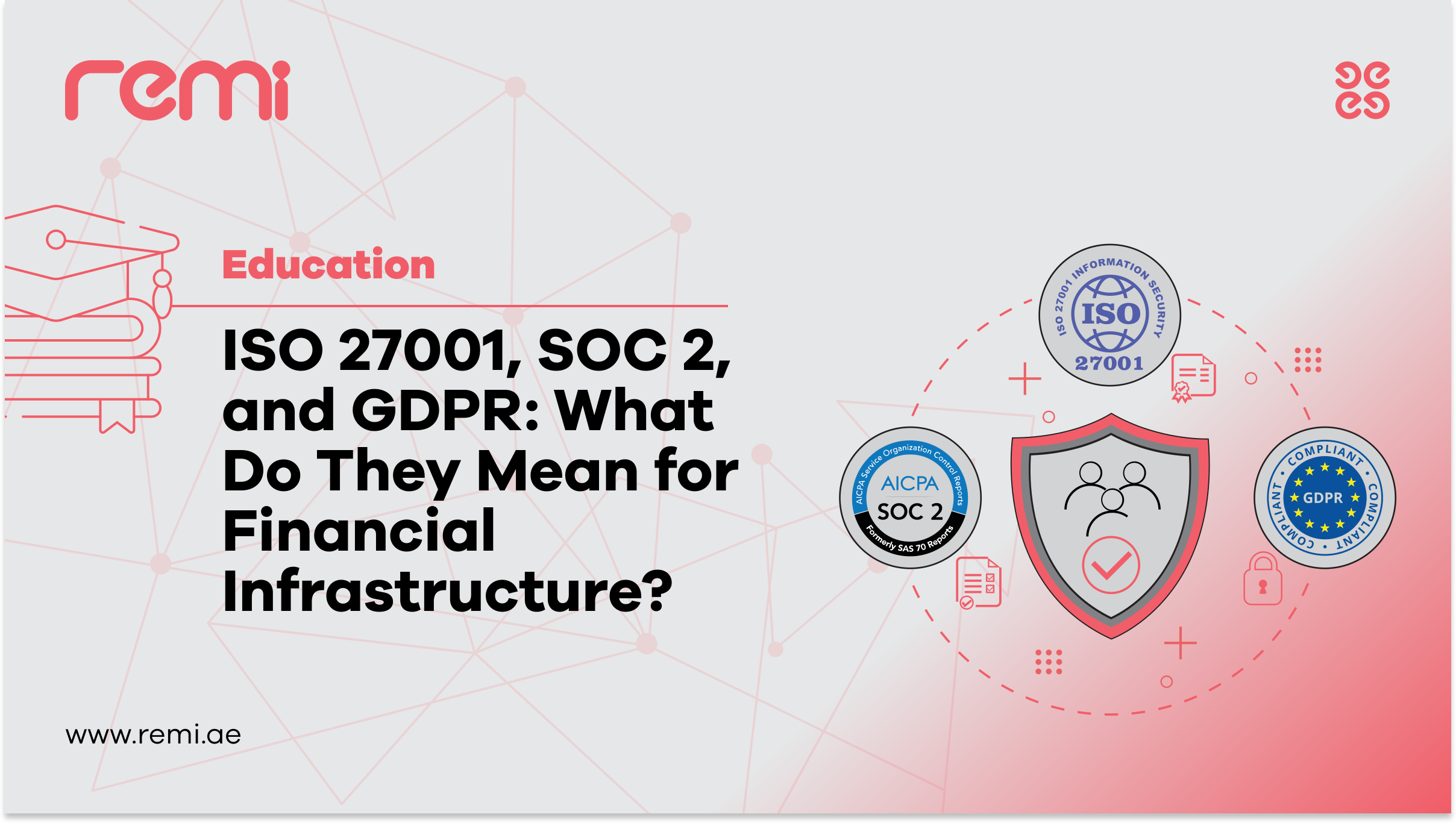
They are often mentioned together, but ISO 27001, SOC 2 and GDPR are not the same thing each answers a different trust question.
Financial infrastructure depends on trust.
Before a bank, fintech, exchange house, or regulated operator connects to a technology platform, they need to understand how that platform handles security, data protection, access control, auditability, and operational risk.
This is why frameworks like ISO 27001, SOC 2, and GDPR matter.
They are often mentioned together, but they are not the same thing. Each one answers a different trust question.
The simple difference
ISO 27001: Security as a management system
ISO 27001 is focused on information security management. It helps an organization define how it identifies security risks, assigns responsibilities, applies controls, monitors incidents, manages access, and improves security over time.
The key idea behind ISO 27001 is that security should not depend on scattered tools or one-time fixes. It should be managed as a structured system.
For financial infrastructure, this matters because sensitive data moves across multiple systems, teams, partners, and environments. A company needs clear policies, controls, ownership, and evidence that security is being managed properly.
SOC 2: Operational trust and control assurance
SOC 2 is about whether a service organization has controls that support trust. It is commonly used by technology companies that serve businesses, especially when customers need assurance around security, availability, confidentiality, processing integrity, or privacy.
SOC 2 does not only ask whether a system exists. It asks whether the controls behind that system are designed in a way that can be reviewed.
For financial infrastructure, this is important because partners need confidence in how the platform operates day to day. They need to know that access is controlled, incidents are monitored, systems are reliable, and sensitive data is handled carefully.
GDPR: Personal data protection
GDPR is different from ISO 27001 and SOC 2. It is not a certificate. GDPR is a data protection regulation that defines how personal data should be collected, processed, protected, retained, and handled.
For financial infrastructure, GDPR matters because money movement often requires personal data. A transaction may involve names, phone numbers, identity information, beneficiary details, account data, compliance checks, transaction records, and payout information.
This data should not be collected without purpose. It should not be exposed unnecessarily. It should not be kept forever without reason. It should only be accessed by the people, systems, and partners that need it.
Why these frameworks matter together
Each framework covers a different part of trust.
- ISO 27001 helps structure how security is managed.
- SOC 2 helps partners evaluate whether operational controls are designed properly.
- GDPR helps define how personal data should be protected and handled.
Together, they help answer the bigger question: can this platform be trusted with sensitive financial workflows?
For financial infrastructure, that question is critical. A platform may offer fast APIs, modern UX, or low transaction costs, but regulated partners also need confidence in the control environment behind the product.
Why this matters in cross-border money movement
Cross-border money movement is complex. It can involve multiple jurisdictions, currencies, payout methods, compliance obligations, financial institutions, and technology providers.
This makes trust frameworks especially important. A transaction is not just a payment instruction. It is a chain of operational events:
- customer and beneficiary validation
- quote generation
- compliance screening
- risk checks
- routing decisions
- payout execution
- settlement confirmation
- webhook updates
- reporting and reconciliation
- audit logging
Each step depends on secure systems and responsible data handling.
Common misunderstanding
A common mistake is to describe ISO 27001, SOC 2, and GDPR as "three certificates." That is not accurate. A more accurate way to describe them is:
- ISO 27001 certification
- SOC 2 attestation or report
- GDPR compliance or GDPR-aligned data protection
This distinction matters because regulated partners care about precise language. Trust depends not only on having controls, but also on communicating them correctly.
Closing
ISO 27001, SOC 2, and GDPR are not just compliance labels. They are part of how modern financial infrastructure proves it can protect systems, data, and operational workflows.
For any company building in regulated money movement, these frameworks help turn trust from a claim into something partners can review, evaluate, and rely on.