
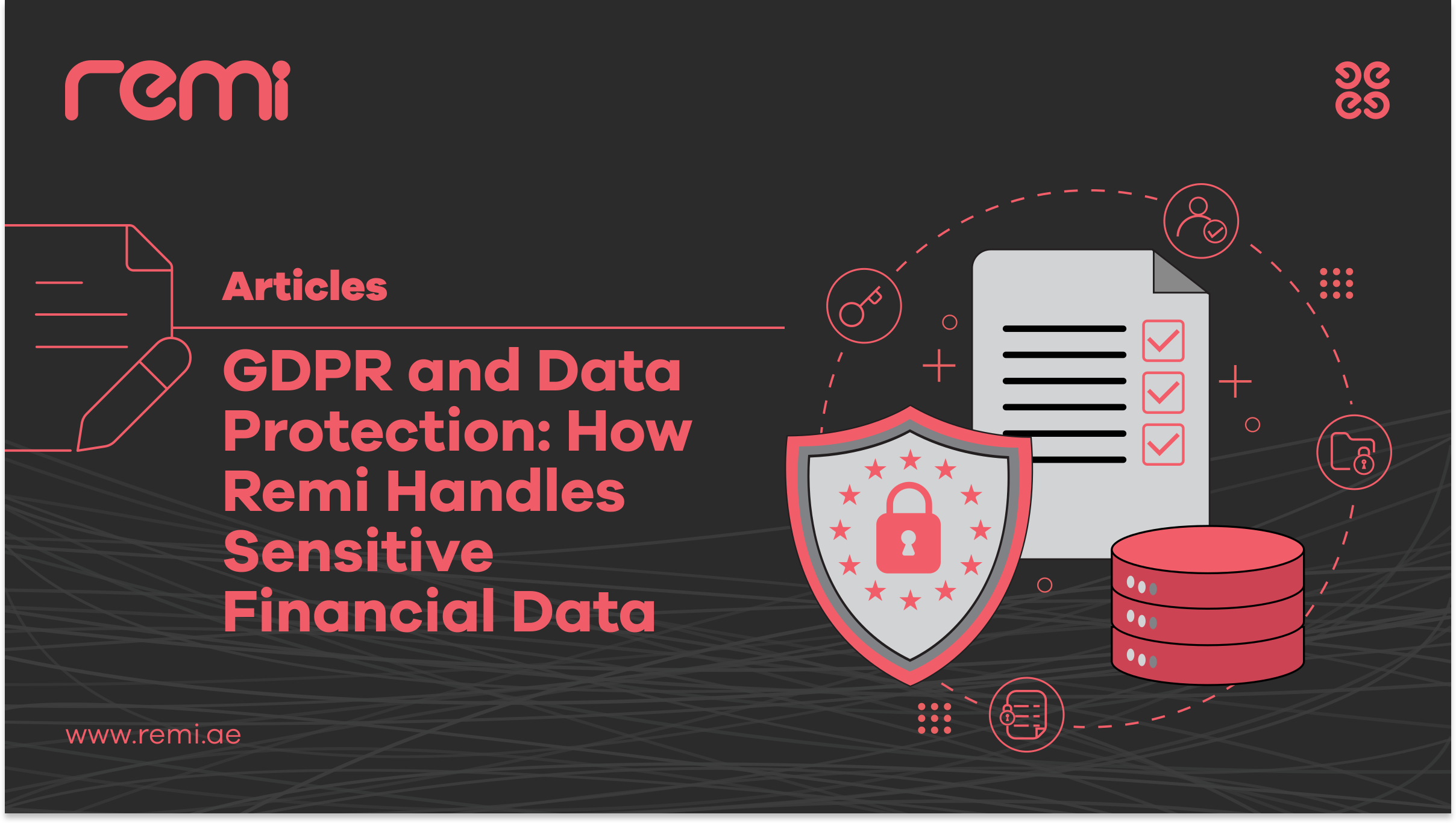
GDPR and Data Protection: How Remi Handles Sensitive Financial Data
Global money movement depends on sensitive data and for regulated infrastructure, protecting it is not optional. It is part of the transaction.
Global money movement depends on sensitive data.
A single transaction can involve sender information, beneficiary details, bank or wallet references, identity verification status, compliance checks, transaction purpose, payout information, and settlement records.
For regulated financial infrastructure, protecting this data is not optional. It is part of the transaction.
This is why GDPR-aligned data protection matters for Remi.
GDPR is not a certificate
GDPR is not a certificate. It is a data protection regulation and privacy framework that sets expectations for how personal data should be collected, processed, protected, retained, and handled.
For Remi, the important point is not to present GDPR as a badge. The important point is to show that data protection principles are reflected in how the platform is designed and operated.
Why privacy matters in money movement
Financial data is deeply personal.
In cross-border money movement, this data can reveal who someone supports, where money is going, how often they send, what amounts they transfer, and which financial channels they use.
This creates a strong responsibility to protect personal and transaction data. For Remi, privacy is also a compliance requirement.
Network Participants and Network Operators need confidence that personal data is handled with clear purpose, controlled access, appropriate retention, and proper security safeguards.
The data protection challenge
A regulated transaction is not just a payment instruction. It may involve multiple data categories:
identity data
beneficiary data
transaction data
compliance data
risk signals
payout data
settlement references
reconciliation records
audit logs
Each category has to be handled carefully. Some data is needed to execute the transaction. Some data is needed for compliance. Some data is needed for audit and dispute resolution. Some data should only be visible to specific roles or systems.
This is why privacy needs to be built into the infrastructure itself.
How Remi approaches GDPR-aligned data protection
Remi's approach is based on several principles.
Purpose limitation
Data should be collected and processed for defined purposes, such as transaction execution, compliance review, payout routing, reconciliation, reporting, or legal obligations.
Data minimization
The platform should avoid unnecessary data collection. Only the data required for the transaction, compliance process, or operational need should be handled.
Access control
Sensitive personal and financial data should only be accessible to authorized users, systems, and partners with a valid business or compliance need.
Security and confidentiality
Personal and financial data should be protected through security controls such as encryption, authentication, authorization, logging, and monitoring.
Retention discipline
Financial infrastructure often has legal and regulatory retention requirements. The goal is to retain what is required, for as long as required, while avoiding uncontrolled data storage.
Auditability
Data access, transaction state changes, compliance decisions, and operational actions should be traceable. Auditability helps support compliance review, partner reporting, investigation, and accountability.
Why this matters for partners
For banks, fintechs, exchange houses, and embedded finance platforms, data protection is part of vendor trust. Partners need to know that Remi is designed to support privacy-aware workflows across regulated transaction activity. This includes:
controlled handling of personal data
privacy-aware system design
role-based access
secure API interactions
auditable data processing
retention and deletion logic where applicable
compliance support across jurisdictions
Privacy and blockchain
Data protection is also important when discussing blockchain-based financial infrastructure.
Public blockchain systems can expose transaction metadata in ways that are not suitable for regulated finance. Even when identities are not directly visible, wallet activity can become linkable over time.
For financial institutions, pseudonymity is not the same as privacy. This is one reason Remi's architecture emphasizes confidential transaction handling and regulated execution paths.
The goal is to support modern settlement infrastructure without exposing sensitive financial information unnecessarily.
Closing
GDPR-aligned data protection matters because cross-border money movement cannot be separated from personal data.
For Remi, privacy is not a legal page hidden in the footer. It is part of how regulated infrastructure should be designed.
As Remi grows across participants, operators, corridors, and use cases, protecting sensitive financial data remains a core part of building trust in the network.