
SOC 2: Why Operational Assurance Matters for Financial Infrastructure
When a partner integrates with financial infrastructure, they are not only asking whether the product works. They are asking whether the system can be trusted.
When a partner integrates with financial infrastructure, they are not only asking whether the product works.
They are asking whether the system can be trusted.
- Can it protect sensitive data?
- Can it operate reliably?
- Can it preserve confidentiality?
- Can it produce audit evidence?
- Can it support regulated workflows without creating operational blind spots?
These are the questions SOC 2 helps address.
What SOC 2 means
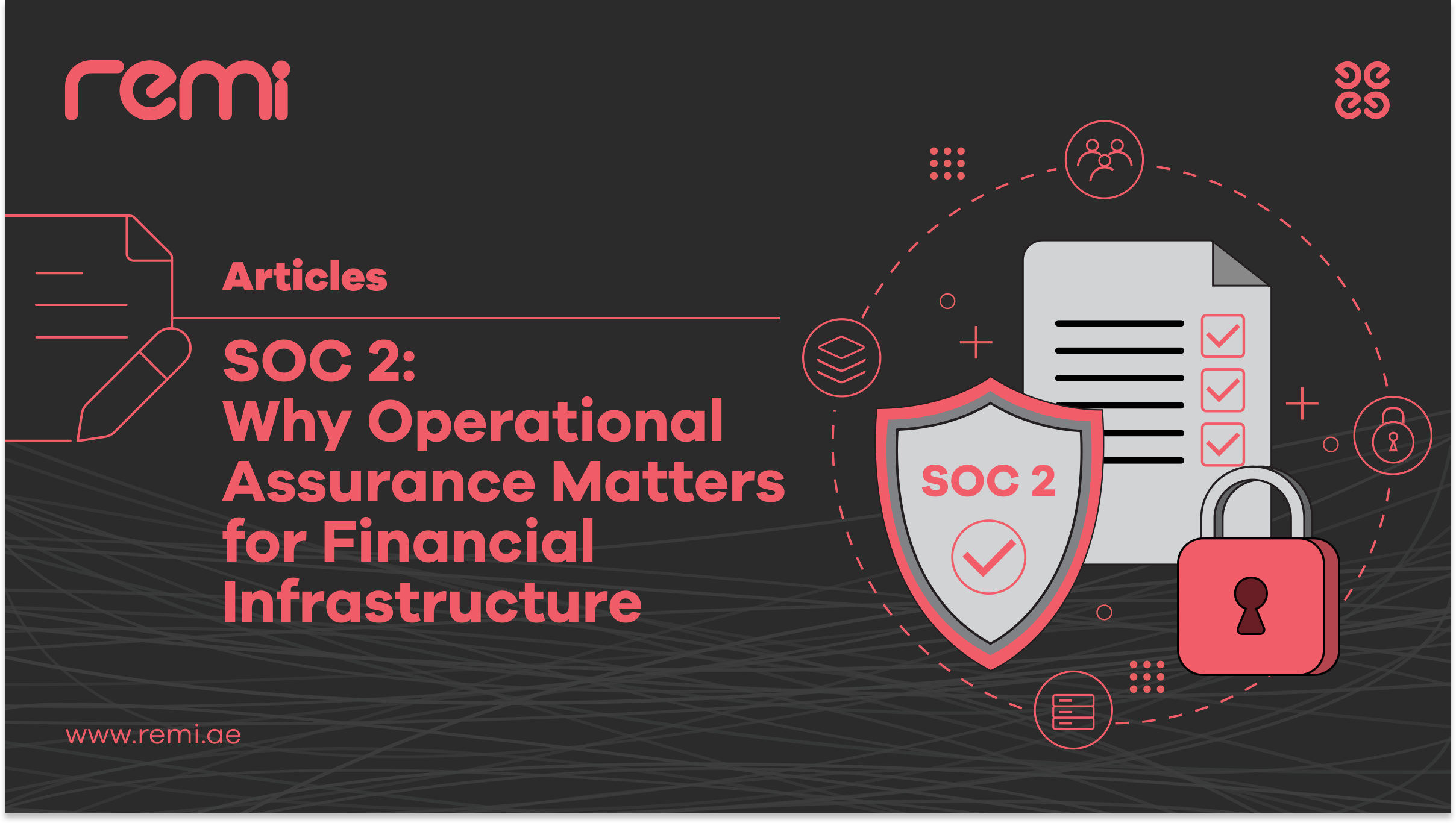
SOC 2 is an independent attestation framework used to assess controls at service organizations. It focuses on trust service areas such as security, availability, processing integrity, confidentiality, and privacy.
For financial infrastructure companies, SOC 2 is important because partners need a structured way to evaluate whether the company has proper controls in place. It is not just about saying "we are secure." It is about showing that the organization has designed controls that can be reviewed, tested, and trusted.
Why SOC 2 matters for Remi
Remi is building a programmable control plane for regulated cross-border money movement. The platform coordinates transaction activity between Network Participants and Network Operators.
Participants use Remi's inbound API to originate transactions, request quotes, manage beneficiaries, track status, and receive webhooks. Remi then routes execution through regulated operators such as banks, exchange houses, money transfer operators, and digital asset custodians.
This model creates a high need for operational assurance. Every transaction must be traceable from initiation to completion. Every compliance decision must be recorded. Every payout instruction must be associated with a route, an operator, a status, and a settlement reference.
That is why SOC 2 is relevant.
The controls that matter most
For Remi, SOC 2-aligned controls are especially important across several areas.
Access control
Only authorized users, systems, and partners should be able to access sensitive services and data. Access must be role-based, logged, reviewed, and limited to business need.
Availability
Financial infrastructure must be reliable. Partners need confidence that critical APIs, transaction status flows, webhooks, and reporting systems are designed for production-grade operations.
Confidentiality
Transaction data, partner information, operational records, and financial details must be protected from unauthorized exposure. This is especially important when multiple institutions interact with the same infrastructure layer.
Monitoring and incident response
A controlled platform must be able to detect unusual behavior, monitor failures, alert teams, and respond to incidents in a structured way.
Auditability
Regulated financial infrastructure must preserve records. That includes logs, transaction state changes, compliance decisions, payout confirmations, and reconciliation references.
Why partners care about SOC 2
For banks and regulated operators, SOC 2 helps support vendor risk review. For fintechs and embedded finance platforms, SOC 2 helps reduce integration uncertainty. For internal compliance and security teams, SOC 2 provides a clearer framework for reviewing whether controls exist and whether they are designed appropriately.
In short, SOC 2 helps translate trust into reviewable evidence.
Operational trust is part of infrastructure
Remi's role is not simply to move data from one party to another. The platform coordinates routing, compliance, settlement, payout status, reporting, and reconciliation.
This makes operational trust a core part of the product. If the system is not auditable, it is not ready for regulated finance. If the system is not secure, it is not ready for institutional partners. If the system is not reliable, it is not ready to become infrastructure.
SOC 2 helps Remi formalize these expectations.
Closing
SOC 2 matters because financial infrastructure depends on trust that can be reviewed. For Remi, this is part of building a platform that banks, fintechs, operators, and partners can evaluate with confidence. Operational assurance is not a side benefit. It is part of what makes Remi infrastructure.